

Mainland vs Free Zone – which one is better for your business in 2026?
Dubai has established itself as a global hub for business setup thanks to its business-friendly laws, modern infrastructure and investor-friendly policies. But one of the most common questions new investors ask is still the same:
“Should I set up my company in Mainland Dubai or in a Free Zone?”
The answer depends on your business model, target market, industry and budget. Both Mainland company setup and Free Zone company setup have clear advantages, and the mainland vs free zone decision can make or break how easily your business scales. In this mainland vs free zone guide, we compare ownership, licensing, tax, visas, costs and timelines step by step, so you can choose with confidence.
Quick Summary: Mainland vs Free Zone at a Glance
- Free Zone: 100% foreign ownership, low starting cost (from AED 5,565), fast licensing, and 0% corporate tax only on qualifying free zone income.
- Mainland: Full UAE market access, government contracts and unlimited branches, starting from AED 18,000, with 9% corporate tax on taxable profit above AED 375,000.
- Choose based on: where your customers are, the activity you need, your visa plans and your budget.
What is a Mainland Company Setup in Dubai?
A mainland company is licensed by the Department of Economy and Tourism (DET) in Dubai, or by the equivalent economic department in other emirates. This structure suits businesses that want to operate without restrictions within Dubai, across the UAE and internationally.
Key Features of Mainland Company Setup:
- Business Scope: Trade directly with customers anywhere in the UAE and abroad.
- Ownership: 100% foreign ownership is allowed for most commercial and industrial activities since the UAE’s 2021 reform.
- Government Contracts: Eligible to bid for government and semi-government contracts.
- Branch Expansion: Open unlimited branches, shops and offices across the UAE.
- Office Space: A registered office with an Ejari tenancy contract is required; business-centre desks are accepted for many activities.
- Visa Quotas: Visa allocation grows with your office size, so larger teams are easy to support.
📌 Noted Point: Some regulated or strategic activities (such as oil and gas, banking, insurance and defence-related work) may still require a UAE national partner, a local service agent or special approvals.
What is a Free Zone Company Setup in Dubai?
A free zone company is incorporated under a Free Zone Authority (FZA). Dubai has more than 20 free zones, and many of them focus on specific industries such as commodities, media, technology, logistics or healthcare. Popular examples include Dubai Multi Commodities Centre (DMCC), Jebel Ali Free Zone (JAFZA), Dubai Airport Freezone (DAFZA), IFZA and Meydan Free Zone.
Key Features of Free Zone Company Setup:
- Ownership: 100% foreign ownership for every activity the zone permits.
- Corporate Tax: 0% applies only to qualifying free zone income; other taxable profit above AED 375,000 is taxed at 9%.
- Customs Benefits: Exemption from customs duty on goods that stay within the free zone or are re-exported.
- Repatriation: 100% repatriation of capital and profits.
- Licensing Speed: Many free zones issue licences within 3–7 working days.
- Office Options: Flexi-desk, shared office and warehouse packages keep costs low.
Free zone companies typically operate inside their zone or internationally. To sell directly to customers in the UAE mainland, they generally need a local distributor, a mainland branch or a special permit (explained below).
Detailed Comparison: Mainland vs Free Zone Company
| Factor | Mainland Company | Free Zone Company |
|---|---|---|
| Licensing Authority | DET + activity regulators (DHA, KHDA, RERA, Dubai Municipality) | Free Zone Authority (DMCC, DAFZA, JAFZA, IFZA, Meydan, etc.) |
| Ownership | 100% foreign for most activities | 100% foreign ownership |
| Trade Scope | Anywhere in the UAE and globally | Within the free zone and internationally |
| Government Contracts | Allowed | Not allowed directly |
| Corporate Tax | 9% on taxable profit above AED 375,000 | 0% only on qualifying free zone income; 9% on other taxable profit above AED 375,000 |
| VAT | 5%; registration mandatory above AED 375,000 taxable supplies | 5%; same registration rules |
| Office Space | Ejari-registered office required | Flexi-desk / shared office available |
| Visa Eligibility | Based on office size | Package-based (often 1–6 visas) |
| Starting Price with Aspira | From AED 18,000 | From AED 5,565 |
| Expansion | Unlimited branches across the UAE | Limited to the zone (mainland branch possible with approval) |
| Banking | Often smoother account opening | Banks may ask for more evidence of substance |
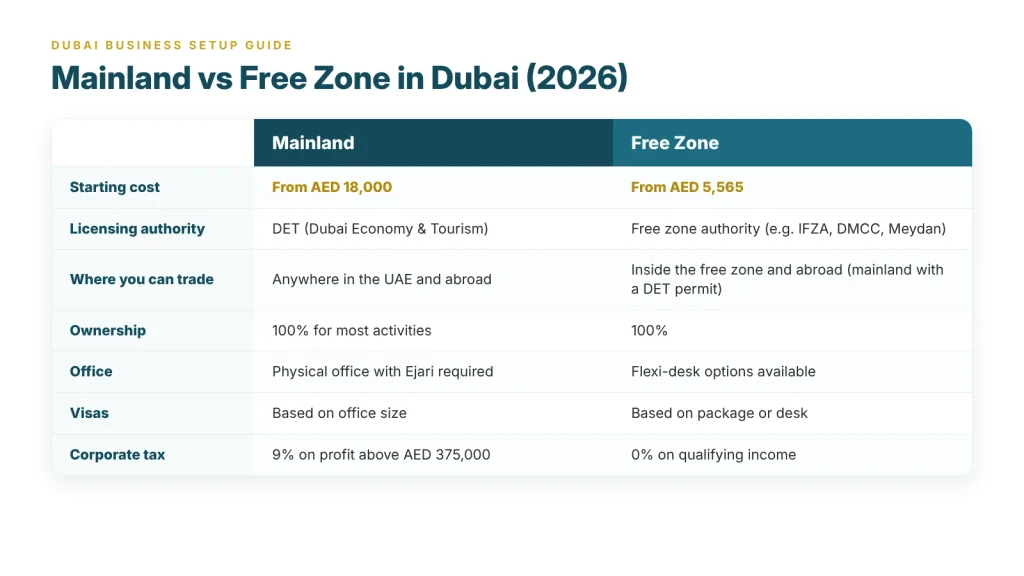
This mainland vs free zone table covers the factors most investors ask about. The next two sections explain the points that cause the most confusion: tax and mainland trading rights.
Corporate Tax and VAT in 2026: Mainland vs Free Zone
The UAE introduced federal corporate tax for financial years starting on or after 1 June 2023, and it applies to both structures. The headline rules for 2026 are:
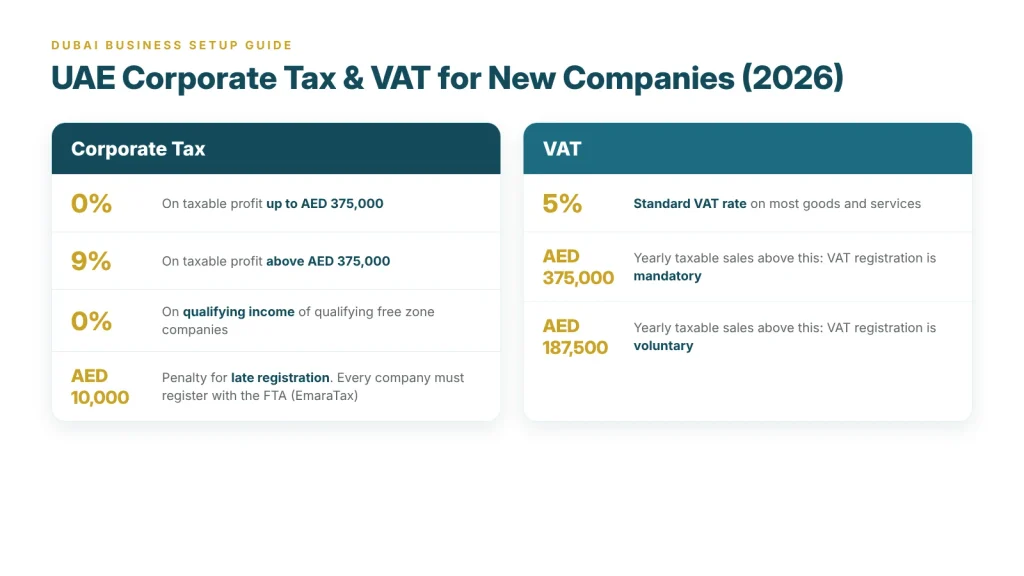
- Mainland companies: 0% on taxable profit up to AED 375,000 and 9% on taxable profit above AED 375,000.
- Free zone companies: 0% only on qualifying free zone income, provided the company meets the Qualifying Free Zone Person (QFZP) conditions. Non-qualifying income is taxed at 9% on taxable profit above AED 375,000.
- VAT: 5% for both, with mandatory registration once taxable supplies exceed AED 375,000 a year (voluntary registration from AED 187,500).
To keep the 0% rate, a free zone company usually needs adequate substance in the zone, audited financial statements, transfer pricing compliance and income that falls within qualifying activities. Too much non-qualifying revenue, such as mainland sales above the de minimis limit, can cost a company its qualifying status for the year. In the mainland vs free zone tax debate, the old “tax-free free zone” idea is outdated – the real question is whether your income will qualify.
Whichever route you choose, every company must register for corporate tax with the Federal Tax Authority, keep proper books and file an annual return. Our accounting services team can help you stay compliant from day one.
Can a Free Zone Company Trade on the Mainland in 2026?
Traditionally, no – a free zone company needed a local distributor or a separate mainland licence. Since 2025, Dubai has allowed eligible free zone companies to apply for a DET permit to carry out approved activities in the mainland. This narrows the mainland vs free zone gap, but it comes with fees, activity limits and tax considerations, so it is not a full replacement for a mainland licence.
If most of your customers are in the UAE – retail, restaurants, contracting or local services – a mainland licence is usually the cleaner and more scalable option. If you sell mainly online, to international clients or to other free zone companies, a free zone keeps costs low.
Industries and Their Relevant Authorities
Whichever side of the mainland vs free zone choice you land on, approvals don’t just depend on DET or a Free Zone Authority. You also need clearance from industry-specific regulators.
- Education (KHDA) – For schools, nurseries and training institutes.
- Healthcare (DHA / MOHAP / DHCC) – For clinics, pharmacies and hospitals.
- Construction & Real Estate (RERA / Dubai Municipality) – For contracting, engineering and brokerage.
- Food & Hospitality (Dubai Municipality / Tourism Authority) – For restaurants, catering and hotels.
- Finance (Central Bank / DIFC) – For fintech, banking and investment firms.
- Media & Tech (Dubai Media City, Dubai Internet City) – For advertising, PR, IT services and digital solutions.
- Logistics (JAFZA, DAFZA, Dubai South) – For import/export, shipping and warehousing.
📌 Pro Tip: Always align your business activity with the right regulator. Example: if you’re opening a training institute on the mainland, you’ll need KHDA approval along with a DET licence.
Pros and Cons: Mainland Setup
Weighing the pros and cons is the simplest way to settle the mainland vs free zone question for your business.
✅ Pros:
- Trade across the UAE without restriction.
- Access to government contracts.
- Larger visa quotas linked to office size.
- Wide choice of business activities.
❌ Cons:
- Higher setup and operating cost.
- Ejari-registered office required.
- More compliance and multi-authority paperwork.
Pros and Cons: Free Zone Setup
✅ Pros:
- Lower setup cost (flexi-desk packages).
- 100% ownership and profit repatriation.
- 0% corporate tax on qualifying free zone income.
- Quick licensing process.
- Industry-focused free zones and networking communities.
❌ Cons:
- Direct mainland trade needs a distributor, branch or DET permit.
- Activity scope limited to what the zone licenses.
- Visa quotas restricted by package or office size.
- Must meet QFZP conditions to keep the 0% tax rate.
Looking at both lists side by side, the mainland vs free zone trade-off is clear: market reach and flexibility versus lower cost and speed.
Cost Factor – Mainland vs Free Zone in 2026
Cost is often the deciding factor in the mainland vs free zone choice. Aspira’s current starting prices are:
- Free Zone Setup: From AED 5,565 – ideal for freelancers, consultants and e-commerce start-ups. Packages with visas, Emirates ID and a flexi-desk cost more depending on the zone.
- Mainland Setup: From AED 18,000 – depending on activity, office size, external approvals and number of visas.
Typical costs to budget for:
| Expense Category | Free Zone (Approx.) | Mainland (Approx.) |
|---|---|---|
| Business Licence | From AED 5,565 | From AED 18,000 |
| Office Rent (per year) | Flexi-desk often included; offices AED 15,000 – 50,000 | AED 30,000 – 100,000+ |
| Visa Fees (per visa) | AED 4,000 – 7,000 | AED 3,000 – 6,000 |
| Local Agent / Sponsor | Not applicable | Only if your activity requires one |
| Corporate Tax | 0% on qualifying free zone income | 9% on taxable profit above AED 375,000 |
| VAT Registration | Mandatory above AED 375,000 taxable supplies | Mandatory above AED 375,000 taxable supplies |
Note: Costs vary by emirate, zone and activity. For a full breakdown of licence, visa and office fees, read our guide to business setup cost in Dubai.
At Aspira, you get a transparent quote before you begin – no hidden fees and no surprise charges later. You only pay for what you need.
Timeline: How Long Does Each Setup Take?
Speed is another key mainland vs free zone difference:
- Free Zone: The licence is often issued in 3–7 working days once documents are complete; visas, Emirates ID and a bank account typically add 2–4 weeks.
- Mainland: Standard activities can be licensed in 5–10 working days. Activities needing external approvals (DHA, KHDA, RERA, Dubai Municipality) take longer, and the full process usually takes 3–6 weeks.
At Aspira, our consultants pre-verify everything before submission, so approvals move smoothly. For eligible activities, we also offer priority processing.
Step-by-Step: How to Choose Between Mainland vs Free Zone
- Define your activity – trading, services, consultancy or a regulated activity.
- Map your target market – UAE customers, government clients or international buyers.
- Check ownership rules – confirm 100% foreign ownership is allowed for your activity.
- Plan your team – estimate how many visas you will need in the next 2–3 years.
- Compare total costs – licence, office, visas and renewals, not just the starting price.
- Review the tax impact – check whether your free zone income would qualify for 0%.
- Get expert guidance – speak to Aspira Business Setup to confirm the best structure.
What’s Included in Aspira’s Company Setup Package
Whatever you decide in the mainland vs free zone comparison, we don’t just help you register a company. We provide complete end-to-end support, so your business is ready to operate legally and smoothly.
Our setup package includes:
- Business activity & licence consultation
- Trade name approval
- DET or free zone licensing & document clearance
- Office lease support (Ejari-registered spaces or free zone desks)
- Legal documents (MoA, LSA, if needed)
- UAE residence visa application
- Emirates ID & medical support
- Corporate bank account assistance
- VAT and corporate tax registration
- Bookkeeping & accounting guidance
- Dedicated PRO and document courier support
Ownership Rules and Legal Structures
Ownership is less of a mainland vs free zone deciding factor than it used to be. In most sectors, the UAE now allows 100% foreign ownership on the mainland, especially for professional and commercial licences.
However, some strategic or regulated sectors may still require a UAE national as a service agent or local partner. We’ll guide you through this clearly, and only recommend sponsor-based setups when legally required.
Business types allowed in Mainland:
- Sole Establishment
- Civil Company
- LLC (Limited Liability Company)
- Branch of a Foreign Company
- Representative Office
Common free zone legal forms:
- Free Zone Establishment (FZE) – single shareholder
- Free Zone Company (FZCO / FZ-LLC) – multiple shareholders
- Branch of a foreign or UAE company
Aspira ensures you select the right legal structure that gives you full control and the right protection for your operations.
Business Activities Allowed in Free Zones
Activity choice can also decide mainland vs free zone for you. Dubai free zones support a wide variety of activities, including:
- E-commerce and online trading
- Consultancy and advisory services
- IT and software development
- Logistics and shipping
- Digital media and marketing
- Import/export and distribution
- Education and training
- Health and wellness
- Financial services
Aspira will match your idea with the right zone and licence.
When to Choose Each: Mainland vs Free Zone Use Cases
- Choose a Free Zone if your operations are international or online, you work solo or with a small team, and you want full ownership with minimal bureaucracy.
- Choose Mainland if you plan to target local clients, open retail stores, restaurants or clinics, or bid for UAE government projects.
- Consider Offshore if you only need a holding or asset-protection company with no UAE operations – see our offshore company setup service.
Why Choose Aspira for Your Mainland vs Free Zone Decision?
Choosing between mainland and free zone setup in Dubai can feel overwhelming. That’s where we come in. Our consultants explain every mainland vs free zone option in plain language and handle the whole process for you:
- Unbiased advice based on your activity, market and budget
- Transparent quotes starting from AED 5,565 (free zone) and AED 18,000 (mainland)
- Licensing & approvals, including KHDA, DHA, RERA and Dubai Municipality
- Visa & immigration services for owners, staff and family
- Office space solutions, from flexi-desks to Ejari-registered offices
- Corporate bank account opening support
- PRO services, VAT and corporate tax registration
FAQs on Mainland vs Free Zone
1. Which is better for a startup: mainland vs free zone?
For most start-ups, a free zone is better because of lower costs and faster setup. If your first customers will be UAE-based retail or service clients, mainland is the better long-term choice.
2. Which is better for retail or restaurants?
Mainland, because you need to serve customers directly in UAE markets and open physical outlets.
3. Can a free zone company trade with mainland customers?
Only through a local distributor, a mainland branch or, in Dubai, an approved DET permit for eligible activities. If your main market is the UAE, mainland is usually more practical.
4. Is 100% foreign ownership possible on the mainland?
Yes, for most activities since 2021. Some strategic sectors may still need a UAE national partner or service agent.
5. Do free zone companies pay corporate tax?
Free zone companies pay 0% only on qualifying free zone income and must meet the Qualifying Free Zone Person conditions. Other taxable profit above AED 375,000 is taxed at 9%, the same rate as mainland companies.
6. Which is cheaper: mainland vs free zone?
Free zone setup starts from AED 5,565 with Aspira, while mainland setup starts from AED 18,000. Mainland costs more upfront but offers unrestricted UAE market access.
7. Can I convert a free zone company to mainland later?
Yes. You can open a mainland branch or set up a new mainland company and restructure your licences, following DET procedures. Aspira can manage the transition for you.
8. Which setup is better for e-commerce?
Free zones such as Dubai CommerCity suit online stores selling regionally. If you want local warehousing, cash on delivery and direct sales across the UAE, a mainland licence gives more flexibility.
9. Do I need to visit the UAE?
Many free zones allow remote incorporation. Mainland companies may need one visit for signing or bank account opening, and visa medicals require you to be in the UAE.
Related Organizations
These official bodies regulate company formation, tax and visas under both mainland vs free zone structures:
- Department of Economy and Tourism (DET) – mainland licensing in Dubai
- Federal Tax Authority (FTA) – corporate tax and VAT registration
- Ministry of Human Resources and Emiratisation (MOHRE) – labour contracts and work permits
- GDRFA Dubai – residence visas
- Dubai Chamber of Commerce – business membership and certificates
- DMCC, JAFZA and DAFZA – major Dubai free zone authorities
Conclusion: Making the Right Mainland vs Free Zone Choice
The mainland vs free zone question has no single answer. A free zone gives low costs, fast setup and 0% tax on qualifying income; the mainland gives full UAE market access, government contracts and room to scale. Match the structure to your customers, activity and growth plans – and get expert advice before you commit.
Contact Us
Still unsure about mainland vs free zone? Let Aspira Business Setup guide you from idea to incorporation. We handle trade licences, visas and corporate structuring so you can focus on growth.
📍 Office: 1001, First Floor, AL Nasr Central, 10th Street, Oud Metha, Dubai, UAE
📞 Call/WhatsApp: +971 56 406 6546
📧 Email: info@aspiradubai.com
🌐 Website: www.aspiradubai.com
🕘 Office hours: Mon–Fri 9am–6pm, Sat 10am–2pm