


Starting a business in Dubai remains one of the most rewarding ventures for entrepreneurs worldwide, but the legal requirements for business setup in Dubai involve more moving pieces than most first-time investors expect. From choosing the right structure and registering your trade name to securing licenses, visas, and tax registrations, every step must align precisely with UAE regulations. Missing even one requirement can result in delays, penalties, or license suspension.
This guide covers everything you need to know about the legal requirements for business setup in Dubai in 2026, including the specific laws governing company formation, exact timelines, required documentation, and the ongoing compliance obligations that continue long after your license is issued.
Understanding Dubai’s Legal Framework for Business Setup
Dubai’s legal framework for business setup in Dubai is governed primarily by Federal Decree-Law No. 32 of 2021 on Commercial Companies, which was further amended in 2025 to reflect the UAE’s evolving approach to foreign ownership and corporate structuring. This law defines ownership structures, registration procedures, and the legal obligations every registered company must follow as part of the broader legal requirements for business setup in Dubai, regardless of whether you choose a mainland, free zone, or offshore structure.
Understanding the legal requirements for business setup in Dubai starts with recognizing how comprehensive the UAE’s activity classification system actually is. Dubai offers over 2,000 business activity options across six main license categories, and your chosen activities determine everything about the legal requirements for business setup in Dubai you’ll need to satisfy, including which type of trade license applies and which regulatory authority oversees your business. Selecting activities that genuinely match your business plans, rather than the broadest possible classification, keeps your setup process cleaner and helps you meet the legal requirements for business setup in Dubai without unnecessary compliance issues down the line.

Choosing the Right Business Structure
The foundation of meeting the legal requirements for business setup in Dubai starts with selecting the correct structure, since this determines your ownership rights, taxation, visa eligibility, and ability to trade within or outside the UAE.
A Mainland LLC remains the most common structure for businesses wanting the flexibility to operate across the UAE and beyond. These companies are licensed by the Dubai Department of Economy and Tourism and can take on government contracts, work with private companies, and open branches anywhere in the UAE. Importantly, the Ministry of Economy and Tourism has confirmed that LLCs carry no minimum capital requirement, meaning you can establish this structure without depositing large amounts of capital upfront, a fact many first-time entrepreneurs aren’t aware of when budgeting for the legal requirements for business setup in Dubai.
A Free Zone Company offers 100% foreign ownership, simplified regulations, and tax benefits, with popular options including DMCC, IFZA, JAFZA, RAKEZ, and Shams. Each free zone operates under its own authority with distinct licensing rules and industry focus, making them well suited to e-commerce, tech, logistics, or professional services businesses.
An Offshore Company is primarily used for international trade, holding assets, or wealth management. Offshore businesses cannot trade directly within the UAE but benefit from tax efficiency, confidentiality, and simplified compliance requirements.
Two additional structures are worth understanding as part of the legal requirements for business setup in Dubai. A Branch Office allows companies already established outside the UAE to expand their operations into Dubai under the parent company’s name and legal identity. A Sole Establishment is owned entirely by one individual, offering full control but carrying unlimited personal liability, an important consideration for solo entrepreneurs weighing risk against simplicity as they navigate the legal requirements for business setup in Dubai.
Choosing the wrong structure could restrict your ability to operate, impact your visa eligibility, and increase your compliance burden, which is why consulting experienced business setup advisors before committing to a structure is one of the most valuable steps in meeting the legal requirements for business setup in Dubai correctly the first time.
Registering Your Trade Name
Your company’s identity begins with a trade name, and this is a formal legal requirement for business setup in Dubai, not simply a branding decision. The Dubai Department of Economy and Tourism for mainland companies, or the respective free zone authority for free zone companies, must approve your trade name before you can proceed.
The naming guidelines are strict. Your business name must be unique and must not conflict with existing registered names or trademarks. It cannot contain offensive, blasphemous, or political terms, and personal names can only be used if they match the shareholder’s passport exactly. Abbreviations are often restricted, and businesses are generally required to submit three trade name suggestions for approval, giving the relevant authority alternatives if your first choice is unavailable or non-compliant.
Once approved, you’ll receive a Trade Name Certificate, one of the first official documents in satisfying the legal requirements for business setup in Dubai and a prerequisite for every subsequent licensing step.
Required Documentation Checklist
Meeting the legal requirements for business setup in Dubai involves assembling a specific set of documents before your application can move forward. At minimum, you’ll need valid passport copies for every shareholder, partner, and manager, with passports valid for at least six months from the application date. If any shareholders already reside in the UAE, copies of their residence visa and Emirates ID are required to confirm legal presence.
You’ll also need recent passport-style photographs with a white background, typically two to four copies, along with your three trade name suggestions for DED or free zone approval. If any shareholders are current UAE residents employed elsewhere, a No Objection Certificate from their current employer or sponsor may be required before proceeding.
For certain regulated sectors like finance, real estate, or consultancy, a detailed business plan explaining your operations, projected performance, and growth goals may be required as part of the legal requirements for business setup in Dubai. If a third party is managing your company formation on your behalf, a Power of Attorney document formally authorizes them to act on your behalf throughout the process.
Obtaining the Correct Trade License
The trade license sits at the heart of the legal requirements for business setup in Dubai, since no company can legally function without one. Dubai issues several distinct license types depending on your business activity.
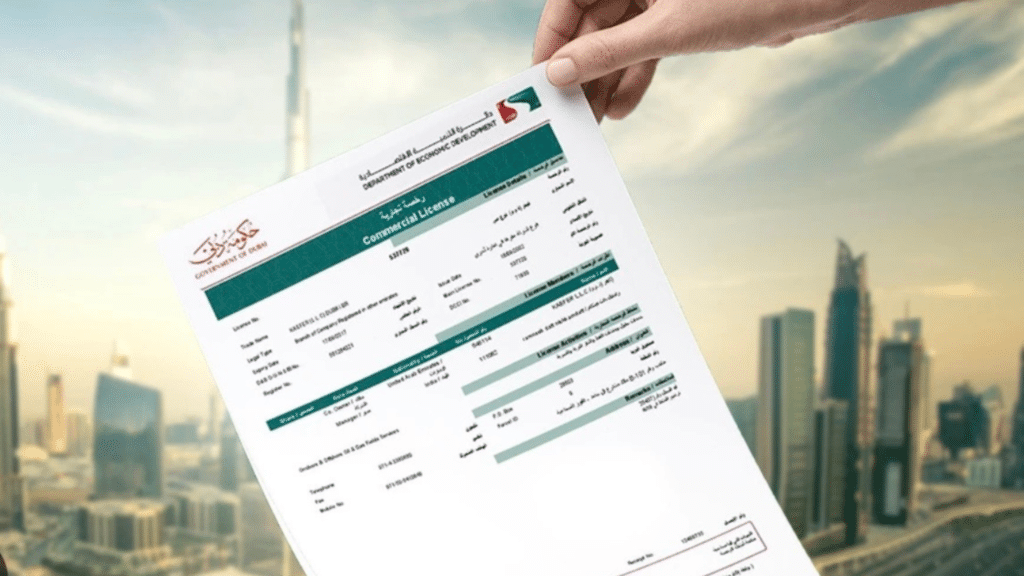
A Commercial License covers trading and commercial activities. A Professional License applies to service providers, consultants, and professionals. An Industrial License is required for manufacturing and industrial operations, while a Tourism License covers travel and tourism-related services. The issuing authority depends on your chosen structure: DED issues licenses for mainland companies, while each free zone issues its own licenses for businesses operating under its jurisdiction.
Realistic Timelines for Company Registration
One of the most frequently overlooked legal requirements for business setup in Dubai is understanding realistic processing timelines, since this directly affects how you plan your launch date. Mainland company registration with the DED typically takes 3 to 7 working days after all documents are submitted correctly. Free zone company setup can move faster, often completing in just 1 to 3 working days for straightforward applications with complete documentation.
Regulated activities requiring external approvals, such as healthcare, education, or financial services, typically take longer than these baseline timelines, since additional regulatory bodies must review and approve your application before your trade license can be finalized. Working with an experienced consultant to ensure all documentation is complete and accurate from the outset is one of the most effective ways to avoid delays extending beyond these standard timeframes.
Understanding Visa and Immigration Requirements
Dubai offers a business-friendly environment, but immigration and visa rules remain strictly regulated as part of the broader legal requirements for business setup in Dubai. An Investor or Partner Visa is required for shareholders or owners, an Employment Visa applies to staff sponsored under the company, and a Dependent Visa covers family members of investors and employees.
Every visa application involves medical fitness testing, Emirates ID registration, and residence permit processing. Visa quotas depend directly on your office space and license type. A company operating from a flexi-desk in a free zone may be eligible for only 2 to 3 visas, while a larger mainland office can support significantly more, depending on the registered floor space. Free zones often bundle visa packages into their company setup offers, while mainland companies may require separate approvals depending on business activity and office size.
Corporate Bank Account Opening Regulations
Opening a corporate bank account is a vital step in completing the legal requirements for business setup in Dubai, though UAE banks follow strict compliance policies to prevent money laundering and ensure financial transparency. Requirements typically include your trade license copy, shareholder passports and residency visas, the company’s Memorandum of Association, a business plan with proof of operations, and an office tenancy contract.
Most banks conduct a thorough Know Your Customer review and may request additional supporting documents depending on the nature of your business activities. Delays often occur because entrepreneurs underestimate the documentation required, and incomplete files or unclear business activity descriptions can result in account rejection. Working with professional PRO services in Dubai significantly streamlines this often-underestimated part of the process.
Essential Business Contracts
Beyond licensing, meeting the full legal requirements for business setup in Dubai means establishing the right contractual protections from day one. Shareholder Agreements define rights, obligations, and profit-sharing arrangements among business owners, preventing disputes as your company grows. Employment Contracts must comply with UAE labour law, covering probation periods, notice periods, and end-of-service benefits for every hire.
Vendor Agreements govern supply relationships, payment terms, and liability clauses with your business partners, while Client Service Agreements protect the scope of work, fees, and intellectual property in your customer relationships. Many entrepreneurs focus entirely on licensing and overlook these contractual foundations, only to face costly disputes later that proper documentation could have prevented.
Taxation and VAT Registration
Dubai maintains a tax-friendly environment relative to most global business hubs, but recent legal reforms mean every entrepreneur must stay informed as part of the legal requirements for business setup in Dubai. In June 2023, the UAE introduced a 9% corporate tax on business profits above AED 375,000, requiring companies to register with the Federal Tax Authority and maintain proper financial records.

Value Added Tax, introduced in 2018, is set at 5%. Any company generating taxable supplies above AED 375,000 must register for VAT, file returns, and pay dues quarterly. Failure to comply with either tax obligation can result in heavy fines, license suspensions, and reputational damage, making accurate accounting systems and support from tax consultants an essential part of ongoing compliance.
Compliance with Labour Laws and Employment Contracts
Labour compliance forms another major pillar of the legal requirements for business setup in Dubai. All employee contracts must be registered with the Ministry of Human Resources and Emiratisation, and companies must use the Wage Protection System to ensure salaries are paid on time and properly documented. End-of-service benefits, working hours, and leave entitlements must all align with UAE Labour Law.
Respecting employment regulations is not only a legal obligation but also builds a positive reputation for your company. Businesses found violating labour laws may face fines, restrictions, or even suspension of operations, making this an area where cutting corners carries real long-term risk.
Industry-Specific Approvals and Permits
Not every trade license covers all business activities. Some industries require special approvals from regulatory authorities in addition to your core license as part of the complete legal requirements for business setup in Dubai. The Knowledge and Human Development Authority oversees schools, training centres, and educational consultancies. The Dubai Health Authority and Ministry of Health regulate clinics, hospitals, and healthcare businesses. Dubai Municipality governs food trading, restaurants, and catering businesses, while the Telecommunications and Digital Government Regulatory Authority oversees IT and telecom activities.
Skipping these special approvals when your business activity requires them can result in operational shutdown along with heavy penalties, so verifying whether your chosen activity needs external approval before starting operations is a critical early step.
Maintaining Ongoing Legal Compliance
Business setup is only the beginning. Ongoing legal compliance forms a continuing part of the legal requirements for business setup in Dubai, ensuring your company stays operational without disruption. Key obligations include annual license renewal, with penalties applying for late renewals, along with accounting audits required for mainland companies and certain free zone entities.
Visa renewals must be managed before expiry to avoid compliance gaps, and businesses in certain sectors must comply with Economic Substance Regulations. Anti-Money Laundering reporting is mandatory for financial and real estate activities specifically. Many entrepreneurs underestimate the importance of this ongoing compliance layer, assuming that once their license is issued, the legal work is complete, when in reality it’s an ongoing responsibility throughout the life of the business.
Why Choose Aspira for Your Business Setup in Dubai
Navigating the full legal requirements for business setup in Dubai, from structure selection and trade name registration to licensing, visas, banking, and ongoing compliance, requires more than a generic checklist. Aspira Business Setup Services brings over 12 years of experience guiding entrepreneurs through exactly this kind of multi-stage, multi-authority process across the UAE.
Our team ensures every legal requirement for business setup in Dubai is met correctly the first time, from trade license approvals and visa processing to tax registration and ongoing compliance management, so you can confidently establish and expand your business in the UAE without the delays that come from incomplete documentation or missed regulatory steps. For entrepreneurs also exploring specific structures in more depth, our guide on Free Zone Company Setup in Dubai breaks down ownership structures and costs across major free zones relevant to your broader business setup decision.
Frequently Asked Questions
1. What are the main legal requirements for business setup in Dubai?
The core legal requirements for business setup in Dubai include choosing a business structure, registering a trade name, obtaining the correct trade license, securing visas, opening a corporate bank account, and registering for applicable taxes including corporate tax and VAT.
2. How long does it take to register a company in Dubai?
Mainland company registration with the DED typically takes 3 to 7 working days after all documents are submitted, while free zone company setup can be faster, often completing in 1 to 3 working days for straightforward applications.
3. Is there a minimum capital requirement for an LLC in Dubai?
No. The Ministry of Economy and Tourism has confirmed that LLCs carry no minimum capital requirement, meaning entrepreneurs can establish this structure without depositing large amounts of capital upfront.
4. Can foreigners own 100% of a business in Dubai?
Yes, in most cases. Over 1,000 business activities in Dubai now permit full foreign ownership without requiring an Emirati partner, though some regulated activities still carry ownership restrictions.
5. What documents are required for business setup in Dubai?
Core documents include shareholder passport copies, residence visa and Emirates ID copies for UAE residents, passport-style photographs, three trade name suggestions, and a Power of Attorney if a third party is managing your setup.
6. Do I need a lawyer to meet the legal requirements for business setup in Dubai?
While not always mandatory, working with an experienced business setup consultant helps ensure your structure, documentation, and contracts are all compliant from the outset, reducing the risk of costly mistakes or delays.
Contact Aspira Business Setup Services LLC
Phone: +971 56 406 6546
Email: info@aspiradubai.com
Website: www.aspiradubai.com