

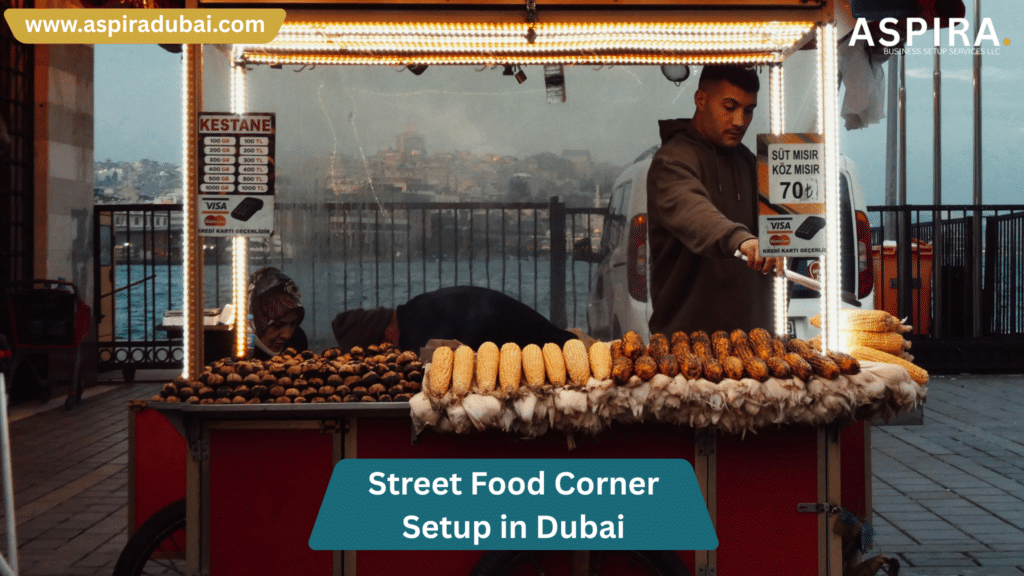
Dubai’s street food scene has exploded alongside its broader food and beverage industry, driven by a diverse population craving quick, affordable, and authentic flavors from around the world. Unlike a mobile food truck, a Street Food Corner Setup in Dubai typically involves a fixed kiosk, cart, or small stall offering a more stable, community anchored alternative for entrepreneurs who want consistent foot traffic without the logistics of relocating daily. This guide walks you through everything involved in a Street Food Corner Setup in Dubai licensing, realistic costs, location approvals, and the operational details competitors rarely cover in depth.
Why a Street Food Corner Differs From a Food Truck
Before diving into licensing, it’s worth clarifying what makes a Street Food Corner Setup in Dubai structurally different from a mobile food truck business. A street food corner operates from a fixed location a kiosk, cart, or small stall positioned in a mall, community area, business district, or approved public space rather than moving between locations throughout the week.
This distinction matters significantly for your licensing path. A fixed corner requires location specific approval tied to a single address, along with utility connections (electricity and water) that a mobile truck doesn’t need. In exchange, a fixed corner typically offers more predictable daily foot traffic, easier repeat-customer relationships, and simpler day-to-day logistics compared to managing a mobile vehicle’s parking permits and daily relocation.
Licensing Requirements for Street Food Corner Setup in Dubai
Running a Street Food Corner Setup in Dubai requires a trade license from the Department of Economy and Tourism (DET), the same core licensing authority overseeing most food and beverage businesses in the Emirate. Beyond the base trade license, your Street Food Corner Setup in Dubai requires food safety approval from Dubai Municipality, since any business preparing or serving food to the public falls under strict health and hygiene regulation.
Trade license – Your DET trade license for a Street Food Corner Setup in Dubai must specify your business activity as a food kiosk, food stall, or street food vending operation, depending on your exact format. This classification determines what your license legally permits a distinction that matters if you later want to expand into catering or packaged food sales.
Food safety approval – Dubai Municipality’s Food Safety Department reviews your kitchen setup, food handling procedures, and supplier documentation through the FoodWatch portal before granting operational approval for your Street Food Corner Setup in Dubai the same regulatory body overseeing restaurants and food trucks across the city.
HACCP compliance – Most food serving businesses, including a Street Food Corner Setup in Dubai, are expected to demonstrate HACCP (Hazard Analysis Critical Control Point) compliance, ensuring your food preparation process meets internationally recognised safety standards.
Location Approval: The Step Competitors Overlook
Unlike a mobile food truck, a Street Food Corner Setup in Dubai requires securing approval for one specific, fixed location and this step involves more layered permissions than most guides acknowledge.
Dubai Municipality location approval – Your fixed stall or kiosk location must be approved by Dubai Municipality as suitable for food service, confirming the space meets spacing, ventilation, and public health requirements for your Street Food Corner Setup in Dubai.
Property owner or mall management NOC – If you’re setting up within a mall, community center, or private development, you’ll need a No Objection Certificate (NOC) from the property owner or mall management before Dubai Municipality will process your location-specific approval for your Street Food Corner Setup in Dubai a step frequently overlooked by first-time applicants who assume municipal approval alone is sufficient.
RTA approval for public spaces – If your corner is positioned in or near a public area affecting pedestrian or vehicle flow, the Roads and Transport Authority (RTA) may need to sign off on your exact placement to ensure your Street Food Corner Setup in Dubai doesn’t obstruct walkways or traffic patterns.
DEWA utility connection – Since your Street Food Corner Setup in Dubai operates from a fixed location, you’ll need to arrange an electricity and water connection through the Dubai Electricity and Water Authority (DEWA) a cost and process entirely absent from most street food corner guides, since mobile trucks typically rely on generators or portable water tanks insteadCost of Street Food Corner Setup in Dubai
Cost of Street Food Corner Setup in Dubai
Cost estimates for a Street Food Corner Setup in Dubai vary based on format, location, and scale, but here’s a realistic breakdown:
- Core trade license and food safety approval: Approximately AED 50,000 for the combined licensing process
- Food license specifically: AED 20,000–50,000, covering Dubai Municipality food safety approval, HACCP documentation, and related certifications
- Total initial operational investment: Often exceeding AED 150,000 once you factor in kiosk/stall construction or leasing, equipment, initial stock, and staffing
- DEWA connection fees: A separate cost specific to fixed-location setups, varying based on your electricity and water load requirements a cost mobile food trucks don’t incur
- Mall/community location fees: If operating within a shopping mall or private development, expect additional rental and revenue-share arrangements beyond standard municipal licensing costs
The wide range in total investment reflects the significant difference between a modest community kiosk versus a premium mall food court stall location ambitions should shape your budget expectations from the outset rather than assuming the lowest published figure covers a fully operational setup.

Staffing and Food Handler Requirements
All staff working at your street food corner from cooks to servers must hold valid health cards issued by Dubai Municipality following mandatory medical screening, confirming they’re fit to handle food for public consumption. Beyond the basic health card, food handlers directly involved in preparation should also complete recognized food safety training, since Dubai Municipality inspections often review staff certification alongside kitchen hygiene during compliance checks.
Given the fixed, often smaller footprint of a street food corner compared to a full restaurant, staffing efficiently matters most successful operators run lean teams of 2-4 staff members covering preparation, service, and basic cleaning duties during operational hours.
Timeline for Street Food Corner Setup in Dubai
The license registration process for a street food corner in Dubai typically takes 2 to 4 weeks, depending on regulatory approvals notably faster than a food truck’s typical 4-6 week timeline, largely because a fixed corner doesn’t require vehicle design approval or mobile inspection scheduling. However, this timeline assumes your location NOC and DEWA connection arrangements are handled in parallel with your licensing application, since delays in securing property approval often become the real bottleneck rather than the trade license itself.
Realistic Break-Even Expectations
While street food corners are often marketed as a low-cost entry into Dubai’s food scene, most operators should realistically expect a break even period of 12 to 18 months, depending on location foot traffic and pricing strategy. Fixed corners in high-traffic malls or business districts typically reach profitability faster than standalone community kiosks, but also carry higher rental and revenue-share costs that offset some of that advantage. Setting realistic break-even expectations upfront rather than assuming rapid returns helps entrepreneurs plan cash flow through the initial months of building a regular customer base.
Popular Street Food Concepts in Dubai
Certain cuisine categories consistently perform well in Dubai’s street food market, reflecting the city’s multicultural population and appetite for quick, flavorful options:
- Fusion cuisines blending regional flavors with familiar street food formats
- Grilled meats, particularly shawarma, kebabs, and grilled skewers
- Seafood, especially in coastal or waterfront locations
- Burger joints with unique or gourmet positioning
- Fast food concepts emphasizing speed and affordability for busy professionals and tourists
Choosing a concept that balances genuine demand with manageable kitchen complexity is often more important to long-term success than chasing the trendiest cuisine alone.
Marketing Your Street Food Corner After Launch
Once your Street Food Corner Setup in Dubai is licensed and operational, sustained success depends heavily on building consistent foot traffic and repeat customers in an increasingly crowded food scene. Unlike a mobile food truck that can chase foot traffic across different locations throughout the week, a fixed street food corner needs to actively draw customers to a single spot making local visibility and community presence essential to long-term profitability.

Social media as your primary channel – Instagram and TikTok remain the most cost effective marketing tools for any Street Food Corner Setup in Dubai, particularly given how visually food-driven these platforms are. Posting high quality images of your dishes, behind the scenes preparation content, and customer reactions helps build organic visibility without significant advertising spend.
Signage and visual branding – Since your corner operates from a fixed location, strong exterior signage and an eye-catching menu board become even more important than they would be for a mobile truck these are often the first thing potential customers notice as they pass by, making the difference between a walk-in and a missed opportunity.
Building relationships with mall or community management – If your Street Food Corner Setup in Dubai is positioned within a mall or private development, maintaining a good relationship with property management can open doors to featured placement during food festivals, promotional events, or seasonal marketing campaigns that management runs to drive overall foot traffic.
Loyalty programs for repeat business – Since a fixed corner benefits from building a regular customer base in its immediate vicinity nearby office workers, residents, or mall visitors simple loyalty rewards or punch-card systems can meaningfully increase repeat visits compared to relying purely on new customer acquisition.
Choosing Between Mall, Community, and Standalone Locations
The specific type of location you choose for your Street Food Corner Setup in Dubai significantly shapes both your costs and your customer base, and it’s worth weighing the tradeoffs carefully before committing to a lease or NOC application.
Mall food courts – These locations typically offer the highest guaranteed foot traffic, since mall visitors are already primed to eat while shopping. However, this convenience comes at a cost mall food court placements often involve higher rent, revenue share arrangements with management, and stricter operational guidelines around hours, branding, and menu presentation compared to independent locations.
Community and residential areas – A Street Food Corner Setup in Dubai positioned within a residential community can build a loyal, repeat customer base among nearby residents, often at lower rental costs than mall placements. The tradeoff is typically lower overall foot traffic volume, since you’re relying on a smaller, geographically concentrated customer pool rather than the high volume flow of a mall environment.
Business district locations. Corners positioned near office towers or business districts benefit from predictable lunch and after work rushes, making them well suited to fast, efficient concepts like grilled meats or burger joints that can serve a high volume of customers during concentrated peak hours.
Standalone street locations – Independent street corners subject to RTA and Dubai Municipality approval for placement offer the most operational flexibility and typically the lowest rental costs, but require more active marketing to build awareness compared to locations with built-in foot traffic like malls or business districts.
Each location type carries distinct licensing considerations too, since a Street Food Corner Setup in Dubai within a mall requires property management NOC in addition to standard municipal approval, while a standalone street location may require additional RTA sign-off depending on its proximity to public walkways or traffic areas.
Scaling Beyond Your First Street Food Corner
Many successful operators use their first Street Food Corner Setup in Dubai as a proof of concept before expanding into additional locations or exploring adjacent formats like food trucks or small cloud kitchens. Once your initial corner demonstrates consistent profitability and you’ve built operational systems around staffing, supply chains, and food safety compliance, replicating that model across a second or third location typically becomes significantly faster than the original setup process since much of the licensing groundwork and supplier relationships are already established.

Entrepreneurs planning this kind of growth trajectory from the outset often benefit from structuring their initial Street Food Corner Setup in Dubai with scalability in mind choosing a jurisdiction and licensing structure that accommodates future expansion rather than optimizing purely for the lowest cost single location setup.
Free Zone vs. Mainland for Your Street Food Corner
Choosing between mainland and free zone licensing affects both your cost structure and where you can physically operate your Street Food Corner Setup in Dubai. Mainland licensing through DET generally offers broader flexibility for placing your corner across various neighborhoods, malls, and business districts, while free zone packages may bundle costs more predictably but can restrict your physical location options depending on the specific zone.
For a deeper breakdown of ownership structures and cost differences across Dubai’s major free zones, our detailed guide on Free Zone Company Setup in Dubai covers exactly how these options compare useful context whether you’re leaning toward a mainland trade license or exploring free zone alternatives for your street food business.
Related Organizations for Street Food Corner Setup in Dubai
When researching or referencing your Street Food Corner Setup in Dubai journey, these are the key government bodies and organizations involved in licensing, approvals, and compliance:
- Dubai Department of Economy and Tourism (DET)
- Dubai Municipality (Food Safety Department)
- Roads and Transport Authority (RTA)
- Dubai Electricity and Water Authority (DEWA)
- Federal Tax Authority
- Aspira Business Setup Services
Why Choose Aspira for Your Street Food Corner Setup in Dubai
Launching a Street Food Corner Setup in Dubai involves coordinating more moving pieces than most first-time entrepreneurs expect DET trade licensing, Dubai Municipality food safety approval, location specific NOCs, DEWA utility connections, and staff health card processing all need to align before you can legally open your doors. Aspira Business Setup Services brings over 12 years of experience guiding entrepreneurs through exactly this kind of multi-agency licensing process across the UAE’s food and beverage sector.
Our team manages every stage of your Street Food Corner Setup in Dubai application from selecting the right jurisdiction and location, to securing property NOCs and Dubai Municipality food safety approval, to coordinating DEWA connections and staff visa processing. We provide transparent, upfront cost estimates so you know exactly what to budget for before committing, helping you avoid the location and utility bottlenecks that most commonly delay first-time street food operators.
Whether you’re planning a modest community kiosk or a premium mall food court stall, Aspira tailors your Street Food Corner Setup in Dubai application to match your specific format and growth ambitions ensuring your licensing, location, and staffing structure is correct from day one.
Frequently Asked Questions
1. How much does a Street Food Corner Setup in Dubai cost?
Core licensing typically costs around AED 50,000, while total initial operational investment including construction, equipment, and initial stock often exceeds AED 150,000 depending on location and scale.
2. How long does it take to set up a street food corner?
The licensing process typically takes 2 to 4 weeks, though location NOC and DEWA connection arrangements can extend your overall timeline if not handled in parallel with licensing.
3. Do I need a food safety approval separate from my trade license?
Yes. Beyond your DET trade license, you need food safety approval from Dubai Municipality’s Food Safety Department, including HACCP compliance documentation.
4. What’s the difference between a street food corner and a food truck?
A street food corner operates from a fixed location requiring DEWA utility connections and location specific NOCs, while a food truck is mobile and requires vehicle design approval and location permits for each operating spot instead.
5. Do I need a mall NOC to open inside a shopping center?
Yes. If operating within a mall or private development, you need a No Objection Certificate from property management before Dubai Municipality will process your location approval.
6. How long until a street food corner becomes profitable?
Most operators should realistically expect a break-even period of 12 to 18 months, depending on location foot traffic, pricing strategy, and rental costs.
Contact Aspira Business Setup Services LLC
📞 +971 56 406 6546
✉️ info@aspiradubai.com
🌐 www.aspiradubai.com