

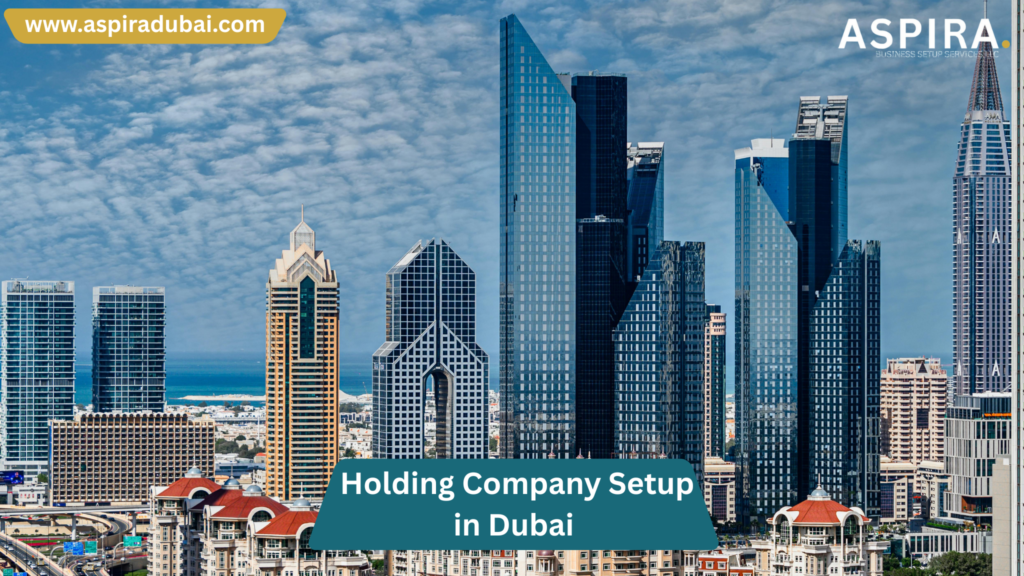
A holding company doesn’t trade, manufacture, or sell. It exists purely to own shares in other companies, hold intellectual property, or consolidate real estate and global subsidiaries under one structure. A properly planned Holding Company Setup in Dubai has become one of the most common strategies for family offices, multinational groups, and individual investors seeking asset protection, tax efficiency, and a stable jurisdiction to consolidate international holdings.
But “holding company” isn’t one single legal structure in the UAE. It’s a decision between at least four distinct pathways, each with different costs, substance requirements, and tax treatment. This guide covers exactly how a Holding Company Setup in Dubai works in 2026: the real jurisdiction choice, actual costs, and the tax rules that are far more conditional than most guides suggest.
What a Holding Company Actually Does
A holding company created through a Holding Company Setup in Dubai owns shares in other companies, holds intellectual property rights, or manages real estate and securities. It does not produce goods or services itself. Think of it as the parent structure that owns and protects the “children” (operating subsidiaries). A family business, for example, might complete a Holding Company Setup in Dubai to consolidate real estate in London, a trading firm in Singapore, and a tech startup locally, all under one UAE parent entity.
Choosing Your Jurisdiction: The Real Decision
This is the part most guides oversimplify. A Holding Company Setup in Dubai isn’t just “mainland or free zone” it’s a choice between four genuinely different legal frameworks:
DIFC (Dubai International Financial Centre) – Operates under English common law with its own independent courts. DIFC’s Prescribed Company regime, updated in 2024, is the go-to structure for holding GCC-registered assets, such as shares in a UAE mainland company or Dubai real estate.
ADGM (Abu Dhabi Global Market) – Also English common law, based in Abu Dhabi. ADGM’s Special Purpose Vehicle (SPV) regime is built for passive asset ring-fencing, but requires every SPV to demonstrate a genuine nexus to the UAE or GCC region through ownership, asset location, or economic benefit. It cannot be used for operational business or staff hiring.
Free Zones (DMCC, IFZA, JAFZA) – Operate under UAE civil law. DMCC’s Holding Company license in particular is built for firms consolidating governance over subsidiaries and investments, and sits within one of the region’s largest and most established free zones.
Mainland (DED) – Suitable for a Holding Company Setup in Dubai that needs to directly own operational businesses trading within the UAE domestic market, though it comes with standard UAE Corporate Tax exposure depending on activity and income.
The honest tradeoff: DIFC and ADGM suit complex inheritance planning, trust structures, and international investors who value English common law precedent. DMCC and other standard free zones are more cost-effective for straightforward commercial holding structures without the need for common-law courts.

SPV vs. Prescribed Company vs. Standard Holding License
Getting the legal vehicle right matters as much as the jurisdiction itself:
- ADGM SPV – A passive, no-staff entity for ring-fencing a single asset, property, or fund interest. Cannot conduct operational business.
- DIFC Prescribed Company – Since the 2024 regulations, open to any global applicant provided a DFSA-registered Company Service Provider acts as director. Ideal for holding GCC-registered assets specifically.
- DMCC/Free Zone Holding License – A standard company limited by shares, suited to holding active trading subsidiaries rather than purely passive asset ring-fencing.
- DIFC Foundation – An orphan structure with no shareholders, purpose-built for family succession and wealth preservation across generations.
The Tax Reality: QFZP Status Isn’t Automatic
A completed Holding Company Setup in Dubai in a free zone can access 0% Corporate Tax on qualifying income but only by meeting Qualifying Free Zone Person (QFZP) requirements, and this is where most guides oversimplify. To qualify, a company must demonstrate genuine economic substance: maintaining a physical office, employing qualified staff where relevant, and holding real board meetings and decision-making activity within the UAE, with signed minutes kept on file. Annual notifications and in some cases economic substance filings must be submitted to the Ministry of Finance to confirm ongoing compliance.
Beyond the free zone rate, the UAE’s network of 140+ Double Taxation Avoidance Agreements (DTAAs) is one of the strongest reasons investors specifically pursue a Holding Company Setup in Dubai properly structured, it can reduce withholding tax on foreign dividends to 0-5%, a meaningful advantage for groups repatriating profits from multiple countries.
Step-by-Step Process
- Define the purpose of your holding structure – real estate, IP management, or consolidating global subsidiaries since this shapes which jurisdiction and vehicle fit best.
- Select your jurisdiction and entity type – DIFC Prescribed Company, ADGM SPV, DMCC/free zone holding license, or mainland, based on the tax and substance tradeoffs above.
- Register your trade name, following UAE naming conventions.
- Draft incorporation documents – Memorandum of Association, shareholder agreements, and passport copies of shareholders and directors.
- Submit to the relevant authority – DIFC Authority, ADGM Registration Authority, the free zone authority, or DED for mainland.
- Complete UBO and source-of-funds disclosure – full transparency of Ultimate Beneficial Owners is mandatory across all UAE jurisdictions for AML/CFT compliance.
- Obtain your license after compliance checks and approvals clear.
- Open a corporate bank account – expect this step to take longer for complex multi-layered ownership structures, since banks generally prefer structures where the UBO appears directly on the license.
- Maintain ongoing compliance – annual audits, AML reporting, and license renewal.
Real Cost of a Holding Company Setup in Dubai
| Structure | Estimated First-Year Cost |
|---|---|
| Free zone holding license (DMCC, IFZA) | From AED 12,500 |
| DIFC Prescribed Company (registered agent) | USD 1,500–3,000/year |
| DIFC non-regulated commercial company | AED 65,000–100,000+ |
| ADGM SPV | From AED 15,000–55,000+ |
| ADGM non-financial commercial entity | From USD 5,500 registration |
| Mainland license renewal | AED 10,000–15,000 |
| Free zone license renewal | AED 12,000–16,000 (incl. flexi-desk) |

Costs vary enormously for a Holding Company Setup in Dubai depending on whether it needs a physical office (generally required for DIFC and ADGM commercial entities, though Prescribed Companies and SPVs often only need a corporate service provider), and whether you require DFSA or FSRA regulatory approval which applies only to regulated financial activities, not standard holding structures.
Benefits of a Holding Company Setup in Dubai
Strategic location – Direct connectivity to Asia, Europe, and Africa, with access to a significant consumer base within a short flight radius, making Dubai a natural regional headquarters location.
Tax efficiency – 0% personal income tax, potential 0% Corporate Tax on qualifying income subject to QFZP rules, and access to 140+ DTAAs reducing cross-border withholding tax.
Asset protection – Separating assets from operational liabilities means that if a subsidiary faces financial or legal trouble, the parent holding company’s assets generally remain protected.
Succession planning – Family-owned groups frequently use a DIFC Foundation or similar structure specifically for wealth transfer across generations, avoiding the complications of inheritance law in other jurisdictions.
Investor and banking confidence – A properly structured Holding Company Setup in Dubai, particularly under DIFC or ADGM’s common law framework, is generally viewed more favorably by international banks and investors than offshore entities in traditional tax havens.
Common Mistakes That Delay Approval
- Choosing DMCC or another civil-law free zone for a structure that actually needs common-law inheritance planning or complex shareholder agreements – only DIFC and ADGM offer this
- Assuming 0% tax is automatic without meeting QFZP substance requirements
- Complex multi-layered offshore structures (for example, a BVI entity feeding into a UAE holding company) facing significantly longer banking compliance checks
- Missing annual economic substance notifications, risking penalties even when no tax is ultimately due
- Underestimating the physical office and substance requirements for DIFC/ADGM commercial entities while assuming SPV-level costs apply
Global Expansion Benefits
A Holding Company Setup in Dubai supports cross-border M&A activity, since holding structures are the preferred vehicle for acquiring companies abroad. It also allows a group to consolidate all international subsidiaries under one UAE entity, simplifying reporting and governance, while the DTAA network reduces friction when repatriating profits from operating subsidiaries back to the parent structure.
Groups using a Dubai holding structure for regional expansion also benefit from proximity to major logistics and financial infrastructure Jebel Ali Port, Dubai International Airport, and the DIFC/ADGM banking ecosystem all sit within the same time zone and business day as operating subsidiaries across the GCC, Africa, and South Asia.
This practical proximity often matters as much as the tax treaty network itself, since it allows decision-makers to maintain genuine oversight of subsidiaries without the coordination lag that comes with holding structures based in more distant jurisdictions like traditional offshore centers.
Banking Considerations for a Holding Company Setup in Dubai
Opening a corporate bank account is often the slowest part of completing a Holding Company Setup in Dubai, and it deserves more attention than most guides give it. Banks generally prefer structures where the Ultimate Beneficial Owner appears directly on the license rather than being obscured behind multiple layers of ownership. A straightforward DIFC Prescribed Company or ADGM SPV with clear, single-layer ownership typically moves through KYC faster than a complex chain running through several offshore jurisdictions before reaching Dubai.
Expect banks to request a clear source-of-funds declaration, shareholder certificates, and for regulated entities audited financials where available. Rejection risk is moderate for brand-new structures with no prior UAE banking relationship, so many investors find it useful to open an account with a bank that already has an established relationship with their chosen free zone or financial centre, since local familiarity with the jurisdiction’s regulatory framework tends to smooth the process considerably.
Working with Family Offices and Wealth Structures
A significant share of overall Holding Company Setup in Dubai activity comes from family offices consolidating multi-generational wealth rather than corporate groups managing operating subsidiaries. For this use case, the DIFC Foundation structure in particular has gained traction — it’s an orphan entity with no shareholders, purpose built for succession planning, and it allows families to register non-Muslim wills for asset succession alongside a robust framework for setting up trusts.
Family offices choosing between DIFC and ADGM for this purpose often weigh proximity to their existing banking relationships and sovereign wealth ecosystem connections DIFC’s is more mature and globally recognized, while ADGM has built strong ties to Abu Dhabi’s sovereign capital network. Neither choice is inherently better; it depends on where the family’s existing financial relationships and future investment focus sit.

Compliance Calendar: What Ongoing Maintenance Actually Looks Like
A Holding Company Setup in Dubai isn’t a one time paperwork exercise. It carries a recurring compliance calendar that’s worth planning for from day one:
- License renewal – Annual, regardless of jurisdiction
- Economic substance notification – Typically due within 6 months of financial year-end for entities claiming QFZP status
- Corporate Tax return filing – Due 9 months after financial year-end, even for entities ultimately paying 0%
- Data protection registration renewal – Applicable specifically to DIFC and ADGM entities, typically an annual fee
- Board meeting documentation – Ongoing requirement to maintain signed minutes evidencing genuine UAE-based decision-making, critical for substance compliance
Missing these deadlines particularly the economic substance notification can trigger penalties even when the underlying entity owes no tax, since the filing obligation exists independently of the tax outcome.
Legal Considerations Beyond Licensing
Beyond the initial Holding Company Setup in Dubai, ongoing legal housekeeping protects the structure’s value over time. Shareholder agreements should be reviewed periodically as the group’s subsidiary structure evolves, particularly after any acquisition or divestment that changes what the holding company actually owns. For structures holding intellectual property specifically, keeping trademark and patent registrations current across every jurisdiction where the IP is licensed prevents gaps that competitors or bad-faith actors could otherwise exploit.
Groups using their Dubai entity for cross-border M&A should also maintain clear internal documentation of each acquisition’s rationale and valuation basis not just for tax authorities, but because banks and future investors conducting due diligence will expect a clean paper trail showing how the holding structure’s asset base was built over time.
Choosing Between Common Law and Civil Law Jurisdictions
The common law versus civil law decision deserves its own dedicated attention in any Holding Company Setup in Dubai, since it affects far more than just court procedure. DIFC and ADGM’s English common law framework governs contract interpretation, shareholder disputes, and inheritance matters using precedent-based reasoning familiar to international investors, lawyers, and banks already operating under UK, Singapore, or Hong Kong law. This familiarity itself has commercial value it reduces legal uncertainty for cross-border contracts and makes international counterparties more comfortable engaging with the structure.
Civil law jurisdictions like DMCC, IFZA, and mainland Dubai operate under a different legal tradition, generally offering lower setup and renewal costs alongside easier access to investor visas for family members. For a Holding Company Setup in Dubai built purely to consolidate commercial subsidiaries without complex cross-border inheritance or trust requirements, civil law jurisdictions are often the more practical and cost-effective choice. The decision ultimately comes down to whether the added cost of common law infrastructure buys you something your specific structure actually needs succession planning across multiple legal systems, complex shareholder agreements, or engagement with counterparties who specifically require common law contracts or whether it’s paying a premium for prestige you don’t functionally require.
Why Work With Aspira Business Setup Services
Aspira Business Setup Services LLC manages the complete Holding Company Setup in Dubai process from selecting the right jurisdiction between DIFC, ADGM, DMCC, or mainland, to structuring the correct legal vehicle for your specific goals, whether that’s an SPV, Prescribed Company, or standard holding license. Our team coordinates document preparation, UBO disclosure, and bank account introduction so investors and family offices can move from planning to a fully operational structure without unnecessary delays.
FAQs on Holding Company Setup in Dubai
Q: What is the difference between a holding company and a subsidiary?
A: A holding company owns shares and controls subsidiaries, while subsidiaries carry out the actual daily operations and trading activity.
Q: Should I choose DIFC, ADGM, or a standard free zone for my Holding Company Setup in Dubai?
A: DIFC and ADGM suit complex international structures needing English common law and inheritance planning; DMCC and standard free zones are more cost-effective for straightforward commercial holding structures.
Q: Do holding companies in Dubai pay Corporate Tax?
A: Free zone entities can access 0% tax on qualifying income, but only by meeting Qualifying Free Zone Person substance requirement. It is not automatic.
Q: Is a physical office required for a Holding Company Setup in Dubai?
A: Generally yes for DIFC and ADGM commercial entities, though DIFC Prescribed Companies and ADGM SPVs often only require a corporate service provider rather than a full office.
Q: Can a Dubai holding company own intellectual property?
A: Yes, a Holding Company Setup in Dubai can hold patents, trademarks, copyrights, and license them globally.
Q: What is an SPV and how is it different from a standard holding company?
A: An SPV (Special Purpose Vehicle) is a passive entity used to ring-fence a single asset or fund interest and cannot conduct operational business, unlike a standard holding license which can hold active trading subsidiaries.
Q: How long does a Holding Company Setup in Dubai take?
A: Non-regulated structures typically complete within a few weeks; DFSA or FSRA regulated financial entities can take several months due to additional regulatory review.
Q: Can foreign investors fully own a Dubai holding company?
A: Yes — free zone and DIFC/ADGM structures allow 100% foreign ownership, with full profit repatriation permitted.
Contact Us
Aspira Business Setup Services LLC
Phone: +971 56 406 6546
Email: info@aspiradubai.com
Website: www.aspiradubai.com